
A structurally differentiated approach to muscarinic agonism
Schizophrenia treatment still forces a tradeoff between efficacy and tolerability.
Most approved antipsychotics still work primarily through dopamine receptor blockade, a mechanism first identified decades ago. For many people living with schizophrenia, that approach falls short — whether through incomplete control of symptoms, limited impact on negative and cognitive symptoms, or side effects that make long-term treatment difficult to sustain.
Muscarinic agonism has re-emerged as a genuinely new mechanism of action for schizophrenia. But first-generation muscarinic approaches activate receptors broadly across the body, and peripheral cholinergic effects — most notably gastrointestinal discomfort — remain a real barrier to adherence and long-term use.
We think the next generation of muscarinic medicines needs to be engineered from the ground up for receptor selectivity and targeted delivery, not adapted after the fact.
Titration and food constraints
Current muscarinic therapy requires a staged dose-escalation schedule, and BID dosing without food. This delays time to therapeutic effect and adds early-treatment complexity for patients and prescribers.
Cholinergic side effects drive discontinuation
Nausea, vomiting, and GI upset are common enough that a peripheral anticholinergic (trospium) co-therapy is layered on — adding dosing complexities and adverse event burden.
Adherence
Tolerable, easily taken medicines are what make sustained treatment possible for patients and caregivers.
Harnessing the Muscarinic Receptor
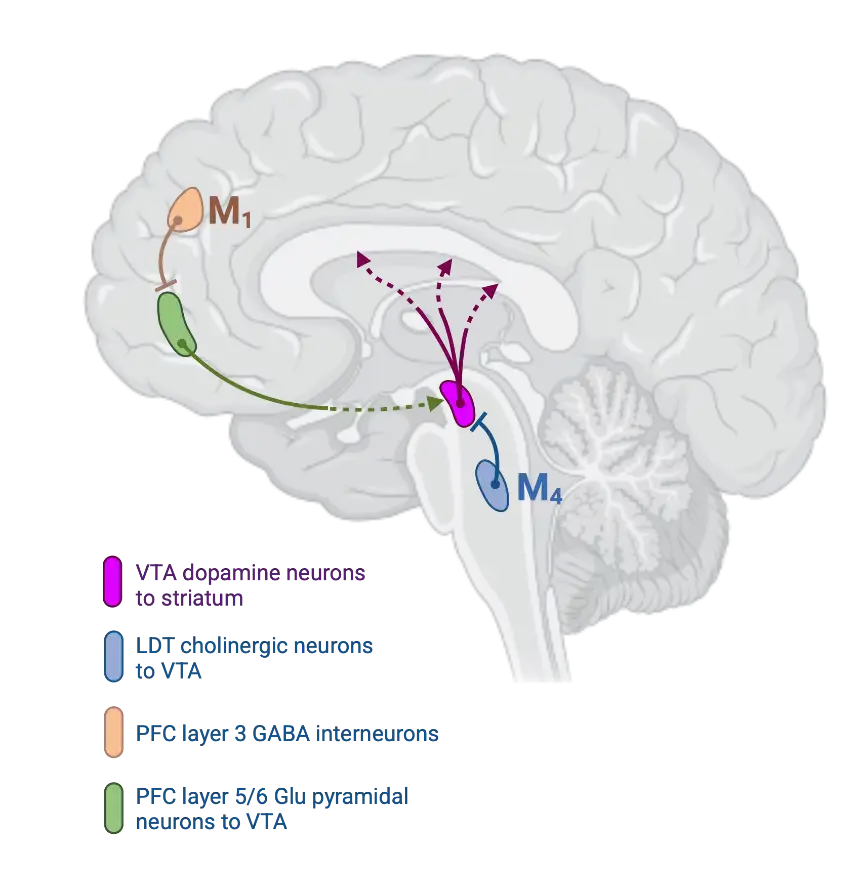
Muscarinic acetylcholine receptors are a family of five G protein-coupled receptor subtypes — M1 through M5 — expressed across the central nervous system and peripheral organs. Two of them, M1 and M4, are concentrated in brain regions known to be involved in cognition and symptoms associated with psychosis. These types form the basis for a new class of antipsychotic mechanism, most recently validated by the first FDA-approved muscarinic-based antipsychotic in 2024.
Both subtypes sit directly in dopaminergic circuitry: M4 autoreceptors are found on ACh neurons projecting to the ventral tegmental area, dampening striatal dopamine release. Conversely, M1 receptors innervate cortical and hippocampal circuits that regulate dopaminergic tone — together offering a route to normalize the dopamine signaling implicated in psychosis without blocking dopamine receptors directly.
CNS — cortex, hippocampus, striatum; autonomic ganglia, gastric glands
Heart (SA node, atria), smooth muscle, CNS
Smooth muscle (airway, GI, bladder, vasculature), exocrine glands, eye
CNS — highly enriched in striatum; also cortex
CNS — substantia nigra/VTA dopaminergic neurons, cerebral vasculature
A highly conserved family, with a twist
Most orthosteric ligands — including acetylcholine itself — bind all five subtypes with similar affinity rather than one selectively, since the core binding pocket is nearly identical across the family.
Subtype-selective compounds instead typically reach the more divergent allosteric vestibule just outside that pocket, either as standalone allosteric modulators or as part of a bitopic ("two-site") ligand that engages both regions at once.
This selectivity challenge is central to why we engineer AN-113 the way we do — see our approach below.
Orthosteric-only ligands
Bind the deep, nearly identical pocket shared by all five subtypes — hard to make selective.
Bitopic ligands
Reach a second, more divergent site just outside the pocket — one basis for subtype selectivity (as with xanomeline, the muscarinic agonist in the first FDA-approved muscarinic antipsychotic).
Yohn S, Weiden P, Felder C, Stahl S. Trends Pharmacol Sci. 2022;43(12):1098–1112. Paul SM, Yohn SE, Miller AC, Felder CC. Am J Psychiatry. 2022;179(9):611–627. Nunes EJ, Addy NA, Conn PJ, Foster DJ. Annu Rev Pharmacol Toxicol. 2024;64:277–289. Caulfield MP, Birdsall NJ. Pharmacol Rev. 1998;50(2):279–290. Kruse AC, Kobilka BK, Gautam D, et al. Nat Rev Drug Discov. 2014;13(7):549–560. Yamada M, et al. Proc Natl Acad Sci USA. 2001;98(24):14096–14101. Davis AA, et al. BMC Pharmacol. 2009;9:14.
Three design principles
Receptor Selectivity
Compounds engineered for greater selectivity toward CNS-relevant muscarinic receptor subtypes, aiming to preserve central efficacy while reducing off-target activity and the need for peripheral blockade.
Targeted CNS Delivery
Materially improved DMPK properties to allow for increased receptor interaction in the brain with the potential for lower dose requirements.
Durable Receptor Engagement
Structurally optimized chemistry intended to support sustained target engagement, guided by structure-activity work across our chemical series.
AN-113 is in preclinical development. These statements describe our research approach and have not been evaluated in human clinical trials.